
 English
- All
- Product Name
- Product Keyword
- Product Model
- Product Summary
- Product Description
- Multi Field Search
English Views: 0 Author: Site Editor Publish Time: 2026-10-24 Origin: Site


Sourcing the right electrical components dictates whether an appliance thrives in the market or fails prematurely. Choosing the optimal insulation class directly impacts warranty claim rates. It also influences overall manufacturing efficiency and product lifespan. Procurement teams often struggle balancing unit-cost savings against premium thermal durability. Standard insulation offers reliable upfront savings for basic functions. However, higher insulation grades prevent rapid winding degradation during heavy-duty cycles. Operating appliances in hot environments without adequate heat protection often leads to sudden mechanical failure. We will break down NEMA thermal limits to clarify these industry standards. We will explore how application-specific component matching solves hidden manufacturing bottlenecks. You will learn to navigate the commercial and technical trade-offs between standard and premium insulation configurations. By matching the exact duty cycle to the right component, buyers optimize both upfront spending and long-term reliability. We also explore vendor verification strategies to guarantee bulk orders meet strict industry standards.
Thermal Thresholds: Class B safely operates up to 130°C, while Class F handles up to 155°C, providing a critical 25°C buffer for high-load applications.
Application Mapping: Intermittent, standard-load components (like spin motors) are highly cost-effective with Class B, whereas continuous, heavy-load components (like wash motors) benefit from Class F.
Strategic Over-engineering: Running a Class F motor at Class B temperature rises is a proven engineering standard to exponentially increase motor longevity without redesigning the appliance footprint.
Cost vs. Reliability: Upgrading to Class F increases upfront unit costs but mitigates thermal degradation in elevated ambient temperatures, reducing long-term failure rates.
The National Electrical Manufacturers Association (NEMA) establishes rigorous standards for electrical insulation. These standards dictate the maximum allowable operating temperature for winding enamel. Operating beyond this limit accelerates thermal degradation. Overheating breaks down the polymer resins protecting the copper coils. This breakdown causes electrical shorts and eventual component failure. Manufacturers specify different insulation classes to match varying thermal stresses in washing machine motors.
Class B insulation is the baseline standard for light-to-medium duty appliances. It features a maximum thermal limit of 130°C. Engineers break this limit down into three specific components. They assume a standard ambient temperature of 40°C. The system allows a maximum temperature rise of 80°C during operation. Finally, it includes a 10°C hot spot margin to account for localized heat pockets. This rating comfortably handles the performance realities of standard residential appliances.
Class F insulation steps up the thermal tolerance to 155°C. It maintains the same 40°C ambient baseline assumption. However, it permits a significantly higher maximum temperature rise of 105°C. It also retains the crucial 10°C hot spot margin. Designers reserve this specification for commercial-grade usage. It proves essential in fluctuating voltage environments. Highly compact appliance housings also trap heat, making Class F a necessary safeguard against poor internal ventilation.
Insulation Class | Max Allowed Temp (°C) | Ambient Baseline (°C) | Max Temp Rise (°C) | Hot Spot Margin (°C) | Typical Application |
|---|---|---|---|---|---|
Class B | 130 | 40 | 80 | 10 | Standard Residential Duty |
Class F | 155 | 40 | 105 | 10 | Heavy/Commercial Duty |
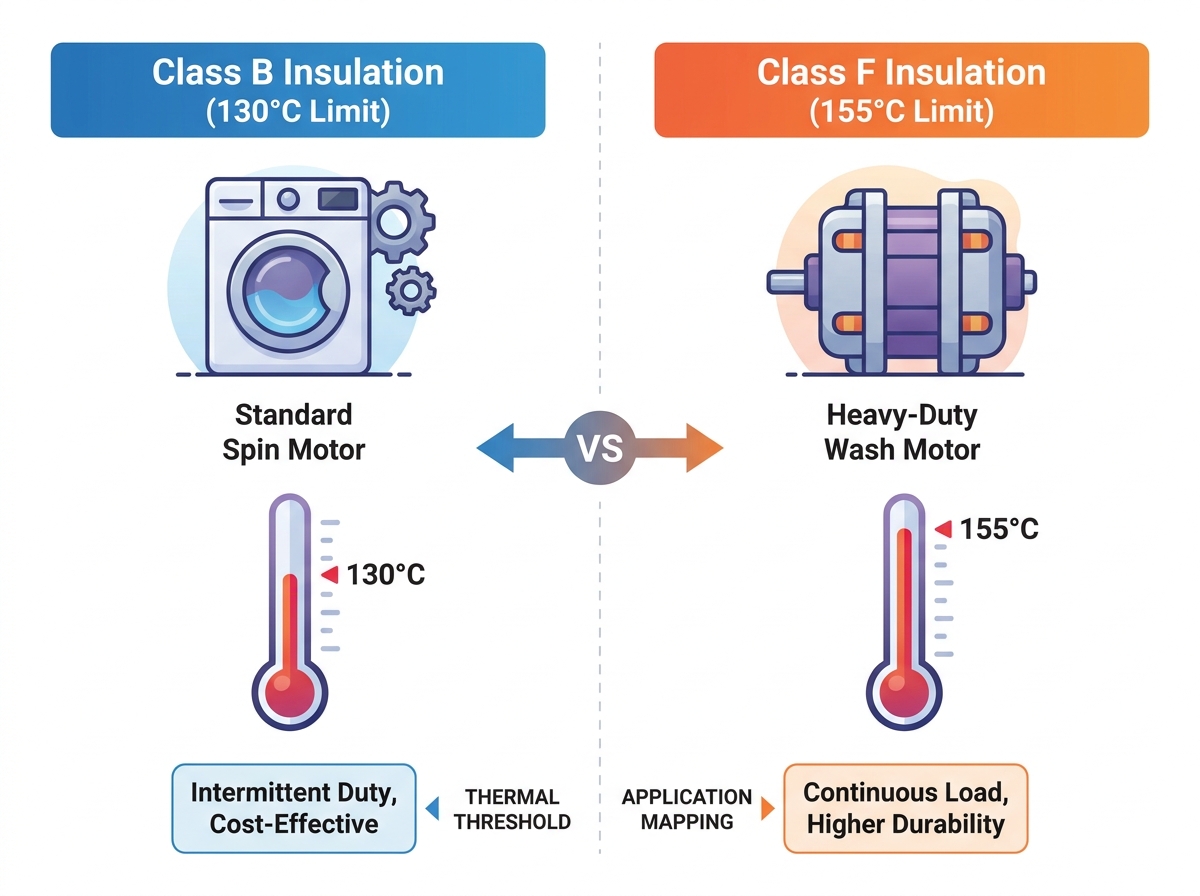
Understanding duty cycles is vital for accurate component selection. Standard spin cycles operate on an intermittent basis. A typical spin duration lasts only five to fifteen minutes. This short burst of high-speed activity rarely generates sustained internal heat. The rapid rotation also acts as an internal fan. Centrifugal forces push ambient air across the copper coils, naturally cooling the assembly. Because of this natural cooling effect, the internal temperature rarely approaches the 130°C threshold.
Procurement teams leverage this operational reality to optimize manufacturing costs. Sourcing a Class B YYG-60 spin motor keeps the bill of materials (BOM) strictly controlled. OEMs can produce highly competitive standard residential washing machines without sacrificing baseline performance. Upgrading intermittent-use components to premium insulation grades often creates unnecessary expense. The standard Class B enamel handles regular consumer laundry schedules perfectly well.
However, implementation risks do exist. Buyers must avoid placing standard components into severe environments. You should warn engineering teams against deploying Class B ratings in commercial laundromat machines. These machines run continuously, eliminating the crucial cool-down periods between cycles. Markets suffering from highly unstable power grids also pose a threat. Sudden voltage spikes force the coils to draw excess current. This current spike causes rapid overheating. In these scenarios, a baseline rating fails prematurely.
The wash cycle demands an entirely different performance profile. Unlike the brief, high-speed spin function, a wash cycle requires continuous, grueling agitation. The components must handle reversing torque constantly. Moving heavy water and saturated clothing back and forth generates intense electrical resistance. This continuous heavy-load operation generates significantly more internal heat. Natural air cooling is less effective during these slower, high-torque movements.
Upgrading your BOM becomes necessary to handle this thermal stress. A Class F 100W wash motor acts as a thermal buffer. It easily absorbs the extreme stress of heavy laundry loads without compromising the winding enamel. Upgrading provides immense durability advantages under harsh conditions.
Heavy Fabrics: Materials like saturated denim and large wet towels exert maximum drag on the agitator. Class F limits prevent the resulting electrical strain from melting the resin.
Continuous Operation: Prolonged wash cycles for heavily soiled garments push internal temperatures past 130°C. The 155°C limit ensures safe continuous operation.
High Ambient Geographies: Appliances operating in tropical or desert climates start at a much higher baseline temperature. A 40°C ambient room leaves very little thermal headroom for a basic rating.
Integrated Washer-Dryer Units: Compact combo machines suffer from inevitable ambient heat bleed. Heat from the drying element transfers into the washing mechanics, necessitating premium heat tolerance.
Ignoring these environmental factors leads directly to premature appliance death. Specifying a higher thermal threshold eliminates the risk of catastrophic coil shorting under load.
Appliance engineers frequently utilize a proven hybrid design approach. They specify premium insulation but intentionally limit the operational heat generation. This philosophy is known as "Class F insulation, Class B rise." The OEM installs a 155°C-rated component. However, the appliance's electrical design ensures the maximum temperature rise never exceeds 80°C under normal load. The component never even comes close to its absolute thermal threshold.
This strategy activates a powerful longevity multiplier. The Arrhenius equation states a well-known engineering rule of thumb for winding degradation. For every 10°C a component runs below its maximum rated temperature, its insulation life approximately doubles. Operating a 155°C-rated part at only 120°C slows the chemical breakdown of the resin exponentially. The component essentially becomes over-engineered for its daily task.
Procurement managers use this framework to justify higher initial unit costs. Upfront spending increases slightly. However, you can calculate a drastic reduction in three-to-five-year warranty replacements. A part running exceptionally cool rarely burns out. Lower warranty claim rates improve brand reputation. This strategy provides a highly predictable, reliable manufacturing outcome without needing a larger, custom-built mechanical footprint.
Buyers must never take supplier insulation labels at face value. Global supply chains contain hidden quality discrepancies. We advise procurement teams to request formal thermal evaluation reports from all prospective suppliers. Specifically, look for IEEE 117 standard testing certifications. These standardized tests verify the actual chemical endurance of the polymer resins. Relying purely on a vendor's marketing sheet invites disaster on the assembly line.
Material substitution is a common industry pitfall. Lower-tier vendors sometimes cut production costs by using standard polyurethane resins. They then fraudulently label these baseline components as premium grades. If installed, these inferior coils melt under heavy agitation loads. You must implement rigorous incoming quality control (IQC) protocols to catch these substitutions early. Random batch testing protects your production run from catastrophic field failures.
To safely navigate these supply chain risks, buyers should follow a strict shortlisting process:
Define the Exact Load Profile: Document the peak ambient environment and exact duty cycles your appliance requires. Outline the heaviest expected laundry loads.
Audit Testing Facilities: Visit potential suppliers or hire third-party auditors. Verify they possess in-house thermal testing ovens and dynamometers to validate their claims.
Review Historical Defect Rates: Request long-term quality control data. Analyze their track record for heat-related warranty claims over a five-year period.
Run Sample Batch Testing: Order a small preliminary batch. Subject these samples to peak simulated load conditions in your own laboratory before finalizing large-volume purchase orders.
Selecting the correct thermal rating directly shapes your product's market success. Class B remains the pragmatic, cost-optimized choice for targeted, intermittent tasks. It handles rapid spin cycles efficiently while keeping manufacturing budgets lean. Standard residential appliances rely heavily on this balanced configuration. However, premium insulation serves as a mandatory safety net for continuous, high-torque demands. Upgrading ensures wash cycles survive heavy agitation and harsh ambient heat without melting internal resins.
We encourage buyers to consult directly with their engineering teams. Map exact duty cycles and anticipated environmental stresses before making a final decision. A hybrid design approach often yields the best reliability metrics. Carefully matching technical specifications to real-world usage patterns prevents expensive warranty disasters. Always verify vendor claims through rigorous independent testing before finalizing large-volume purchase orders.
A: Yes. Upgrading to a Class F motor is perfectly safe and often yields a longer lifespan. The higher thermal tolerance prevents overheating during heavy loads. You only need to ensure the physical dimensions, frame size, and electrical specifications match the original component exactly.
A: No. The insulation class dictates heat tolerance, not electrical efficiency. Power consumption relies entirely on the component's internal design, the physical load applied, and its specific wattage rating. Premium resins do not draw extra electrical current from the wall.
A: Not necessarily. Often, premium motors can be the exact same size or even more compact. Their advanced insulation materials withstand the higher internal heat density of a smaller frame. You do not always need a larger casing to manage thermal stress.
A: NEMA ratings assume a 40°C (104°F) ambient baseline. If the appliance operates in an unventilated, high-heat space, the internal temperature rises much faster. A higher-rated component prevents the total operating temperature from breaching safe limits in these hot environments.


