
 English
- All
- Product Name
- Product Keyword
- Product Model
- Product Summary
- Product Description
- Multi Field Search
English Views: 0 Author: Site Editor Publish Time: 2026-10-19 Origin: Site


In the fast-paced environment of single-phase appliance manufacturing, precision is paramount. Imprecise capacitor selection remains a leading cause of premature motor failure and escalated warranty claims. Engineers routinely face immense pressure to optimize production lines and source components quickly. Yet, ignoring strict capacitor specifications invites mechanical disaster in the field. The stakes are incredibly high for modern appliance brands. A direct correlation exists between dielectric quality, exact capacitance matching, and the operational lifespan of high-torque appliance motors.
A minor component mismatch can render a robust motor completely useless. It stalls drums, overheats windings, and ruins consumer trust. This guide outlines a structured, decision-stage framework for evaluating, specifying, and sourcing run and start capacitors for OEM appliance applications. You will learn how to verify exact tolerances without relying on supplier marketing fluff. We detail how to ensure proper voltage safety buffers and evaluate thermal ratings. We also cover selecting compliant components for rigorous international markets. By following these engineering principles, you protect your brand's reputation and ensure long-lasting appliance performance.
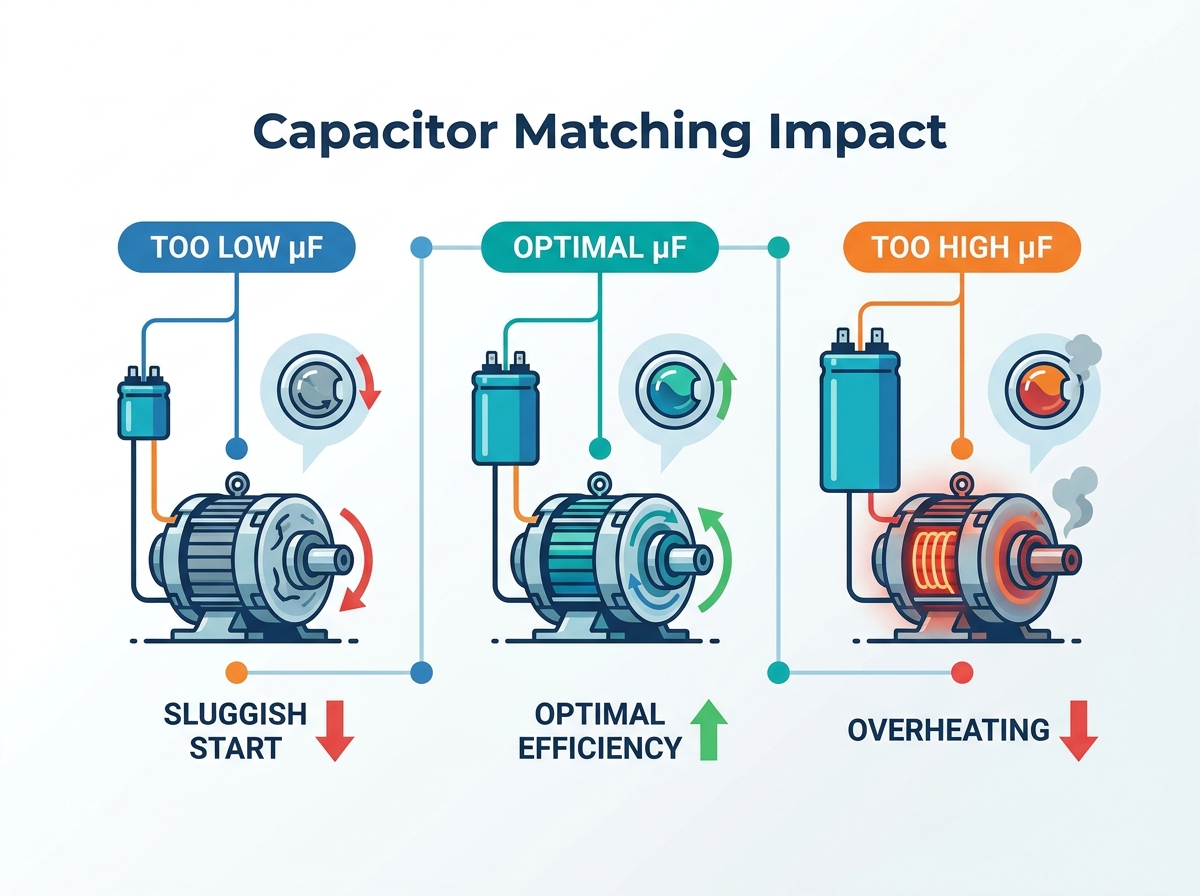
Exact capacitance matching prevents secondary winding overload; oversizing does not yield "more power," it yields excess heat.
Voltage ratings must account for peak operational spikes, not just standard line voltage (e.g., standardizing on 450VAC for 220V markets).
Component compliance (UL/VDE/TUV) and thermal class are non-negotiable evaluation filters for global appliance distribution.
Sourcing logic must weigh batch consistency and self-healing dielectric properties over unit-cost savings to protect long-term brand equity.
Engineers know precise phase shifts generate necessary starting torque. Single-phase motors lack a naturally rotating magnetic field. They require an auxiliary circuit to create this shift. Single-phase washing machine spin motors rely heavily on these precise electrical shifts to function correctly. A mismatched capacitor disrupts this delicate balance immediately. It causes sluggish starts or completely stalled drums during the spin cycle. When a drum stalls, the motor draws dangerous locked-rotor current. This rapidly overheats the internal copper windings. The end-user notices this failure, damaging your brand reputation.
Warranty and assembly costs spiral out of control when specifications fail. A simple $2 capacitor can easily compromise a $40 motor assembly. Batch-failure rates in cheap capacitors directly impact OEM bottom lines. They trigger expensive product recalls across entire distribution regions. They also require costly field service visits to replace ruined motors. You cannot afford to risk expensive assemblies on substandard components. We often observe manufacturers trying to save pennies on electrical components. They end up spending thousands on warranty fulfillment. This imbalance destroys product profitability.
Supply chain standardization offers significant protective benefits. Standardizing capacitor housing sizes streamlines manufacturing processes across various facilities. Terminal types should also remain consistent across multiple appliance product lines. This strategic alignment reduces assembly line confusion. It minimizes human error during rapid mass production. It also simplifies inventory management for busy procurement teams. Fewer unique SKUs mean better overall purchasing power. You can negotiate superior bulk pricing. This strategic approach stabilizes your entire component supply chain.
Capacitance value dictates overall motor efficiency. Standard engineering tolerances usually sit tightly at ±5%. Straying from the exact specification alters the motor's power factor. This mismatch forces the motor to draw excess current from the grid. Excess current generates unwanted heat inside the sealed motor housing. Heat degrades internal wire insulation rapidly over time. A common mistake includes assuming a ±10% tolerance is acceptable for heavy laundry loads. It is absolutely not. You must enforce strict ±5% tolerances during initial procurement.
Voltage rating allowances require careful engineering consideration. You must deliberately over-specify voltage limits. This handles internal back-EMF (Electromotive Force) safely. It also absorbs unexpected external grid fluctuations in developing markets. Standard 250VAC components are often insufficient for 220V/240V main lines. Making 400VAC or 450VAC the standard provides a critical safety buffer. We highly recommend this baseline upgrade for all global shipments. It prevents premature dielectric breakdown. It ensures the component survives violent voltage spikes in regions experiencing unstable power grids.
Thermal ratings matter immensely in compact appliance design. Evaluate components strictly based on standard climatic categories. A common industry example is the 40/85/21 rating profile. Ambient operational heat builds up intensely inside a sealed washing machine chassis. The motor itself radiates significant thermal energy nearby. This ambient heat accelerates internal dielectric degradation if ignored. You must understand what these specific numbers mean for your final product.
Climatic Category Breakdown Specifications
Category Code Parameter | Technical Definition | Practical Application for OEMs |
|---|---|---|
First Number (e.g., 40) | Minimum ambient operating temperature (-40°C) | Ensures safe startup in unheated environments or long-term winter storage. |
Second Number (e.g., 85) | Maximum ambient operating temperature (+85°C) | Crucial for components mounted near high-heat motor coils inside the chassis. |
Third Number (e.g., 21) | Damp heat testing duration in days (21 days) | Validates component moisture resistance in humid, poorly ventilated laundry rooms. |
Applying YYG-60 motor specifications demands exactness from design teams. These specific motors often power popular twin-tub designs globally. They require a perfect electrical balance to operate smoothly. The spin cycle needs rapid, aggressive acceleration. It demands high starting torque to reach maximum RPM quickly, extracting water efficiently. However, continuous running efficiency remains equally important during long cycles. A well-matched capacitor ensures the YYG-60 runs cool. It maintains target RPM without drawing excessive line current. Best practice involves verifying the microfarad rating directly against the motor's specific load curve.
Specifying for a 180W wash motor introduces completely different engineering challenges. Wash motors do not simply spin in one continuous direction. They handle frequent bidirectional rotation driven by control boards. This constant reversing load places cyclical stress on internal capacitor connections. A standard continuous run capacitor might fail early here. It suffers tremendously under this repetitive electrical strain. You need a highly robust component designed to handle rapid polarity shifts. The internal metallized film must endure constant voltage reversals without breaking down.
Dual versus single capacitors present another major assembly logic choice. A single dual-value capacitor combines both motor functions into one housing. For example, a 10µF + 4µF unit handles both wash and spin circuits simultaneously. This saves valuable physical space inside compact machines. It also speeds up factory assembly time significantly. However, two independent capacitors offer much better fault isolation. If one circuit fails, you only replace one small component. OEMs must evaluate their target demographic carefully. Premium appliance models often use separate capacitors to ensure long-term reliability. Budget models frequently rely on dual capacitors for ultimate cost efficiency.
Physical footprint often dictates final assembly decisions on the factory floor. Engineers must carefully assess housing dimensions against available chassis clearance. Both diameter and height matter significantly during modern compact appliance design. A large capacitor rubbing against a vibrating spin drum will eventually short out. Terminal types also impact assembly line efficiency directly. Assembly line workers apply varying degrees of force during connection.
Spade Connectors: Offer rapid installation on manual assembly lines. They require proper crimping tension to avoid loose electrical connections over time.
Insulated Wire Leads: Provide superior overall vibration resistance. They are ideal for high-RPM applications where severe mechanical shaking is inevitable.
PCB Mount Pins: Used primarily when the capacitor integrates directly into a main smart control board rather than utilizing an external wire harness.
Safety mechanisms distinguish premium capacitors from cheap, dangerous alternatives. Specifying Class P2 components is highly recommended for all household appliances. These feature a mechanical fail-safe overpressure disconnect mechanism. Inside a Class P2 capacitor, internal elements sit below an expandable bridge. As internal pressure builds during a catastrophic failure, the top expands outward. This physical expansion snaps the internal connection wire safely. Class P0 lacks this vital safety feature entirely. Class P0 units can rupture forcefully, spraying hot materials. Specifying Class P2 prevents combustion during component failure. It protects the consumer and strictly limits your corporate liability.
Global certifications authorize your manufactured appliance for strict international markets. You must aggressively verify CQC, VDE, UL, and CE marks. OEMs cannot afford any compliance shortcuts in this area. A fake certification mark can trigger massive customs seizures. Verified RoHS compliance remains absolutely mandatory for all European markets. You must ensure no hazardous heavy metals exist within the component. Missing these regulatory marks halts global distribution entirely. Always request independent lab verification from your suppliers before authorizing mass production.
Supplier auditing safely separates reliable manufacturing partners from risky vendors. Evaluate the capacitor manufacturer’s quality control protocols closely during initial visits. Demand 100% end-of-line testing for all major production runs. Do not accept simple statistical batch sampling. Batch sampling allows a small percentage of defective units to slip through unnoticed. In mass production, a 1% failure rate equals thousands of angry consumers. Visit the factory if geographically possible. Verify their testing equipment calibration records to ensure data accuracy. Check their raw material storage conditions. Polypropylene film is highly sensitive to humidity before winding.
Dielectric film quality dictates self-healing capabilities during minor electrical faults. Assess the exact origin and thickness of the metallized polypropylene film used. The widely accepted CBB60 standard relies heavily on this specific material. Superior film ensures minor electrical faults self-heal almost instantly. When a microscopic internal short occurs, the metal film vaporizes locally. This action isolates the fault without destroying the entire component. Cheaper films lack this uniform thickness. They fail completely during very minor grid voltage spikes.
Procurement teams should adopt a standardized, rigorous evaluation approach. Follow these actionable steps closely before signing any high-volume supplier contracts:
Request comprehensive technical datasheets and verify internal construction materials detailed within.
Cross-reference specific component markings directly with global certification databases (like UL Product iQ).
Commission pilot sample runs specifically for internal thermal testing and vibration analysis.
Perform accelerated lifecycle load testing on actual OEM motor assemblies to validate field reliability.
Capacitor selection represents a critical engineering constraint for modern appliances. It is never just a simple procurement line-item meant for aggressive cost-cutting. Prioritizing thermal resilience drastically reduces lifecycle appliance failures in consumer homes. Exact matching to specific motor specs ensures long-term operational reliability. Enforcing fail-safe safety designs strictly protects end-users. It also shields your brand from severe legal liability and recalls. We urge procurement engineers to act decisively today. Product designers must cross-reference their current Bill of Materials immediately. Compare your existing parts against certified capacitor datasheets. Request a technical consultation or a testing sample from a verified, reputable supplier. Proactive technical evaluation today prevents costly warranty claims tomorrow.
A: No. While slightly higher capacitance might temporarily increase starting torque, it will draw higher phase currents, overheating the motor windings and leading to premature failure.
A: Yes. Using a higher voltage rating (e.g., replacing a 300VAC with a 450VAC) is safe and often recommended for longevity, as it provides a larger buffer against voltage spikes. It will not alter the motor's operating characteristics, though the physical size of the capacitor may be larger.
A: Most single-phase washing machine spin motors use Run Capacitors (typically CBB60 metallized film), which stay in the circuit continuously to maintain efficiency. True Start Capacitors are designed for brief, high-torque bursts and will overheat if left in a continuous circuit.
A: Dual capacitors (housing both wash and spin elements) save space and assembly time. However, if one side fails, the entire unit must be replaced. OEMs must weigh assembly cost reductions against the slightly higher field-replacement cost.


