
 English
- All
- Product Name
- Product Keyword
- Product Model
- Product Summary
- Product Description
- Multi Field Search
English Views: 0 Author: Site Editor Publish Time: 2026-08-24 Origin: Site


For appliance manufacturers and commercial repair networks, the motor system represents the most critical point of failure. It heavily influences a unit's Bill of Materials (BOM). Sourcing the correct components prevents disastrous warranty claims. It also protects valuable profit margins. In twin-tub or heavily segmented appliances, mechanical demands change drastically between cycles. Agitating water requires entirely different physical architectures compared to high-speed centrifugal drying. You must treat these workloads as separate engineering challenges.
Understanding the engineering divergence between wash and spin motors is essential. It helps you optimize production costs without compromising appliance longevity. Evaluating cost-effective components ensures competitive pricing on the assembly line. You will learn the exact mechanical differences between agitation and extraction systems. We will also explore how specific winding materials impact thermal management. Finally, you will discover actionable procurement strategies to source resilient components for your production line.
Specifying the wrong motor type leads to premature thermal failure. It can also cause inadequate water extraction. Both issues result in high warranty claim rates. Appliance manufacturers must carefully analyze the distinct physics behind each cycle. A generic approach often destroys profit margins.
Wash Cycle Demands
Spin Cycle Demands
These opposing requirements dictate the structural reality of modern appliances. A single washing machine motor must use complex mechanical clutches. Electronic inverters can also bridge this gap. However, both solutions add significant BOM costs. Conversely, twin-tub systems physically separate these workloads. They utilize two highly optimized motors. This structural division allows engineers to specify distinct electrical characteristics for each task. It prevents thermal overload while maximizing cycle efficiency. We consider this separation a best practice for budget-tier appliance design. It eliminates the need for fragile mechanical gearboxes.
Internal construction varies dramatically between these two components. Engineers design stator and rotor configurations specifically for their designated tasks. Wash motors typically feature balanced start and run windings. These balanced coils facilitate rapid direction changes. They allow the agitator to reverse polarity smoothly. Spin motors utilize distinct primary and secondary windings. Manufacturers optimize these specific coils for single-direction acceleration. Primary windings carry the sustained load during high-speed extraction.
Duty cycle ratings also reveal a stark contrast. Global IEC standards classify these operational differences clearly. Wash motors are rated for intermittent, fluctuating loads. They operate under S3 or S4 duty cycles. These classifications account for frequent starting and stopping. Spin motors receive ratings for short-burst, high-velocity continuous loads. They operate under S2 short-time duty frameworks. They run continuously for brief periods before shutting down completely.
Safety regulations heavily influence braking mechanisms. Spin motors often integrate mechanical or electromagnetic braking systems. These brakes halt the high-speed drum safely when consumers open the lid. High-speed drums carry immense kinetic energy. Stopping them quickly prevents severe injuries. Dedicated wash motors generally lack this feature. They operate at much lower speeds. Water resistance naturally slows the agitator once power cuts off. Adding brakes to a wash unit introduces unnecessary mechanical complexity.
Table 1: Structural and Operational Differences Between Wash and Spin Motors
| Specification Feature | Dedicated Wash Motor | Dedicated Spin Motor |
|---|---|---|
| Winding Configuration | Balanced start and run windings | Distinct primary and secondary windings |
| Rotational Direction | Bidirectional (Reversing) | Unidirectional (Single direction) |
| Operating Speed | Low RPM (High Torque) | High RPM (Low Initial Torque) |
| Standard Duty Cycle | Intermittent / Fluctuating (S3/S4) | Short-burst Continuous (S2) |
| Integrated Braking | Rarely included | Often standard for safety compliance |
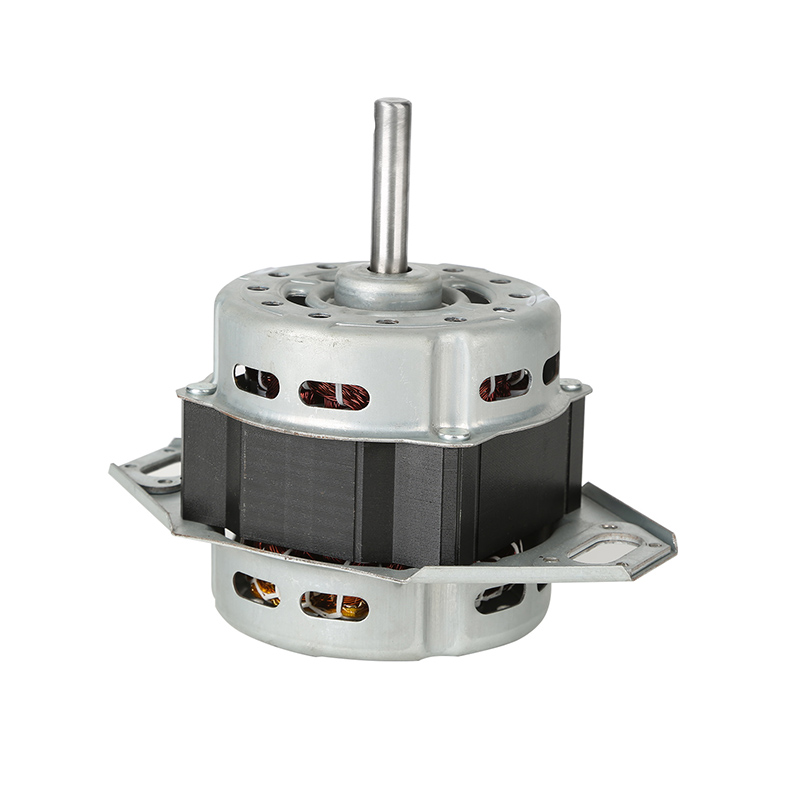
In highly competitive appliance markets, OEMs frequently utilize aluminium windings. This strategic choice reduces overall unit weight. It also lowers raw procurement costs significantly. Commodity prices for copper fluctuate wildly. Aluminium offers a stable, budget-friendly alternative. You must understand where to deploy it safely.
Spin cycles require less raw torque than agitating cycles. The initial hurdle involves overcoming static inertia. Once the drum spins, centrifugal force maintains momentum. This makes a 150W Aluminium Motor perfectly sufficient. It easily powers standard 6kg-8kg capacity extractors. Aluminium provides a highly favorable cost-to-performance ratio. It suits the shorter, high-speed burst operation of a spin tub perfectly. Manufacturers save money without sacrificing essential extraction power.
We must assess the risks and realities transparently. Aluminium has lower electrical and thermal conductivity than copper. It generates more heat under heavy loads. It also dissipates that heat slower. Reputable manufacturers use specific engineering practices to compensate. They deploy a thicker wire gauge inside the stator. This increased diameter lowers electrical resistance. Robust thermal overload protectors are also mandatory. These sensors monitor internal coil temperatures actively. They cut power before insulation degradation occurs. Consecutive spin cycles push thermal limits quickly. Proper engineering prevents catastrophic melting. You should always audit vendor specification sheets carefully. Ensure they specify appropriate wire gauges for aluminium components.
Control system architecture dictates motor selection entirely. Manufacturers choose between mechanical and electronic frameworks. Legacy machines rely heavily on mechanical systems. They use a single, purely electric motor. This motor pairs with a complex mechanical gearbox. A centrifugal clutch switches modes automatically. During agitation, the clutch disengages the main drum. The motor drives the central agitator back and forth. During extraction, the motor spins in one continuous direction. Centrifugal force engages the clutch. The entire drum spins rapidly. These legacy systems are highly durable. However, they remain mechanically complex. Gearboxes strip teeth over time. Clutches wear down after years of friction.
Twin-motor systems bypass these mechanical failure points entirely. They are incredibly common in semi-automatic machines. Engineers utilize separate, purpose-built components. One motor handles washing. The other handles spinning. You eliminate the need for a clutch completely.
Dual-motor systems simplify appliance design in several ways. They reduce strain on the electrical control board. They isolate workloads, preventing single-point failures. If the wash side fails, the spin side might still function. However, implementation considerations exist. Twin motors increase the overall physical footprint. The appliance chassis must accommodate two bulky metal components. Wiring complexity also increases slightly. Assembly line workers must route dual harnesses. Despite these drawbacks, the simplified mechanics often win out. They lower assembly time and reduce warranty repairs on gearboxes.
Evaluating components for shortlisting requires strict technical criteria. You cannot rely on baseline wattage alone. A high wattage rating means nothing if the unit overheats. Use the following dimensions to audit potential suppliers.
We advise ordering sample units before mass production. Run them through localized load testing. A common mistake is testing units without simulated wet garments. Always test under real-world, water-logged conditions. This reveals true thermal performance.
The divide between wash and spin motors lies in fundamental physics. Wash cycles demand low-speed torque for heavy agitation. Spin cycles demand high-speed centrifugal force for water extraction. Treating them as identical engineering tasks leads to premature failure. Twin-tub systems solve this by dividing the labor mechanically.
For OEMs and procurement managers, auditing specific duty-cycle requirements is crucial. This audit dictates your final BOM decisions. It reveals whether a premium copper-wound inverter is necessary. Often, a cost-optimized aluminium alternative delivers the exact performance metrics needed. You simply must engineer the thermal protections correctly.
We highly recommend requesting detailed specification sheets immediately. Benchmark thermal overload data across multiple suppliers. Order sample units for localized load testing inside your specific chassis. Finalize your BOM integration only after these physical endurance tests pass.
A: No, not without a mechanical clutch or an electronic inverter. A dedicated wash motor lacks the high-speed RPM capabilities and unidirectional efficiency required for effective centrifugal water extraction.
A: Wash motors require significant power (often 300W-400W) to overcome the inertia of heavy, water-soaked clothes during bidirectional agitation. Spin motors (e.g., 135W-150W) only need to maintain high-speed rotation in one direction once the initial inertia is overcome.
A: Yes, provided it is used in the correct application (like the spin cycle) and is manufactured with a larger wire gauge to offset aluminium's lower conductivity compared to copper. Integrated thermal protectors are critical for ensuring its longevity.
A: The most common causes are water leaks penetrating the motor bearings, capacitor degradation leading to starting failure, and repeated overloading that bypasses the thermal fuse.


