
 English
- All
- Product Name
- Product Keyword
- Product Model
- Product Summary
- Product Description
- Multi Field Search
English Views: 0 Author: Site Editor Publish Time: 2026-10-13 Origin: Site


Cross-border appliance manufacturing demands strict adherence to regional electrical standards. Expanding into global markets requires navigating complex power grids safely. Procuring the wrong frequency motor for a target market leads to catastrophic field failures. A 50Hz unit shipped to North America, or a 60Hz unit shipped to Europe, triggers rapid warranty spikes and compliance violations.
You cannot fix these electrical mismatches with simple voltage transformers. For traditional AC induction machines, supply frequency directly dictates rotational speed and thermal performance. This physical reality forces appliance engineers to specify internal components accurately. Ignorance of grid variations guarantees damaged reputations and recalled product lines.
We designed this guide to equip OEM procurement teams and engineers with a solid technical baseline. You will learn to evaluate frequency-specific specs and understand the real-world risks of mismatching. We will also help you shortlist reliable manufacturing partners to ensure safe, compliant mass production.
Speed Variance: Motor RPM is directly tied to frequency. A 20% difference in Hz equals a 20% difference in operational speed.
Thermal Overload Risks: Running a 60Hz-rated motor on a 50Hz supply causes magnetic saturation, leading to rapid overheating and insulation failure.
Torque Degradation: Running a 50Hz motor on a 60Hz supply reduces available torque, stalling the wash drum under full load capacity.
OEM Sourcing Imperative: Accurate specification of motor power and torque ratings specifically mapped to the target region’s grid is non-negotiable for compliance (UL/CE).
Electrical frequency acts as the heartbeat of an AC induction system. It defines exactly how fast the internal magnetic field rotates. Engineers must understand this relationship when sourcing reliable washing machine wash motors for global markets.
The rotational speed of an AC induction motor is governed by a strict mathematical rule. We calculate this using the synchronous speed formula: RPM = (120 × Frequency) / Poles. The number 120 is a constant representing electrical degrees, while poles refer to the magnetic coils wound inside the stator.
Consider a standard four-pole design. On a 50Hz European grid, the synchronous speed is exactly 1500 RPM. Move that exact same unit to a 60Hz North American grid, and the synchronous speed jumps to 1800 RPM. Induction motors experience a slight lag called "slip" to generate torque, but their actual running speed remains proportionally locked to this baseline formula.
Induction systems require a constant V/Hz ratio to maintain optimal magnetic flux. Magnetic flux is the invisible force bridging the stator and the rotor. We find this ratio by dividing the supply voltage by the frequency. For example, a 230V / 50Hz supply provides a ratio of 4.6 V/Hz.
Changing the frequency without adjusting the voltage severely alters this ratio. If the ratio drops, the magnetic field weakens. If the ratio spikes, the iron core absorbs too much energy. Maintaining a balanced V/Hz ratio prevents efficiency losses and ensures consistent mechanical output.
Frequency dependency applies primarily to traditional AC induction designs. You will find different tolerances in other common appliance technologies:
Universal Motors: These utilize carbon brushes and a commutator. They operate on both AC and DC power. Frequency changes barely affect their speed, making them highly versatile for basic appliances.
BLDC (Brushless DC) Motors: These connect to an inverter board. The appliance converts incoming grid AC power into DC power. The board then synthesizes a custom frequency to drive the unit.
Even with BLDC systems, you must still ensure the main electronic control board handles the region's input voltage safely. However, the motor itself remains insulated from direct grid frequency variations.
Shipping an appliance designed for London (50Hz) to New York (60Hz) creates immediate mechanical problems. The appliance will power on, but internal dynamics shift drastically.
Grid frequency increases from 50 to 60. This represents a 20% jump. Because RPM links directly to frequency, the motor spins 20% faster than its original design parameters dictate. An impeller meant to agitate water at 1400 RPM will suddenly spin at roughly 1680 RPM.
This 20% speed boost wreaks havoc on carefully engineered wash profiles. The agitation becomes overly aggressive. Fabrics suffer accelerated wear, stretching, and tearing. Furthermore, the drum bearings face higher centrifugal forces. They wear out prematurely, leading to loud vibrations and early mechanical failure in the field.
While the machine spins faster, it actually loses strength. Remember the V/Hz ratio. A 230V supply at 50Hz equals 4.6. If you apply that same 230V at 60Hz, the ratio drops to 3.83. The magnetic flux decreases significantly.
Because flux drops, the unit produces less starting and running torque. The machine might agitate violently when empty, but it will struggle to start spinning a drum packed with heavy, wet towels. It can easily stall under full load capacity.
If your drain pump also relies on an AC induction design, the 20% speed increase causes fluid dynamics issues. Centrifugal pumps are highly sensitive to speed. Spinning 20% faster often induces cavitation. The impeller creates air pockets in the water rather than pushing the liquid. The machine fails to drain efficiently, leaving clothes soaking wet at the end of the cycle.
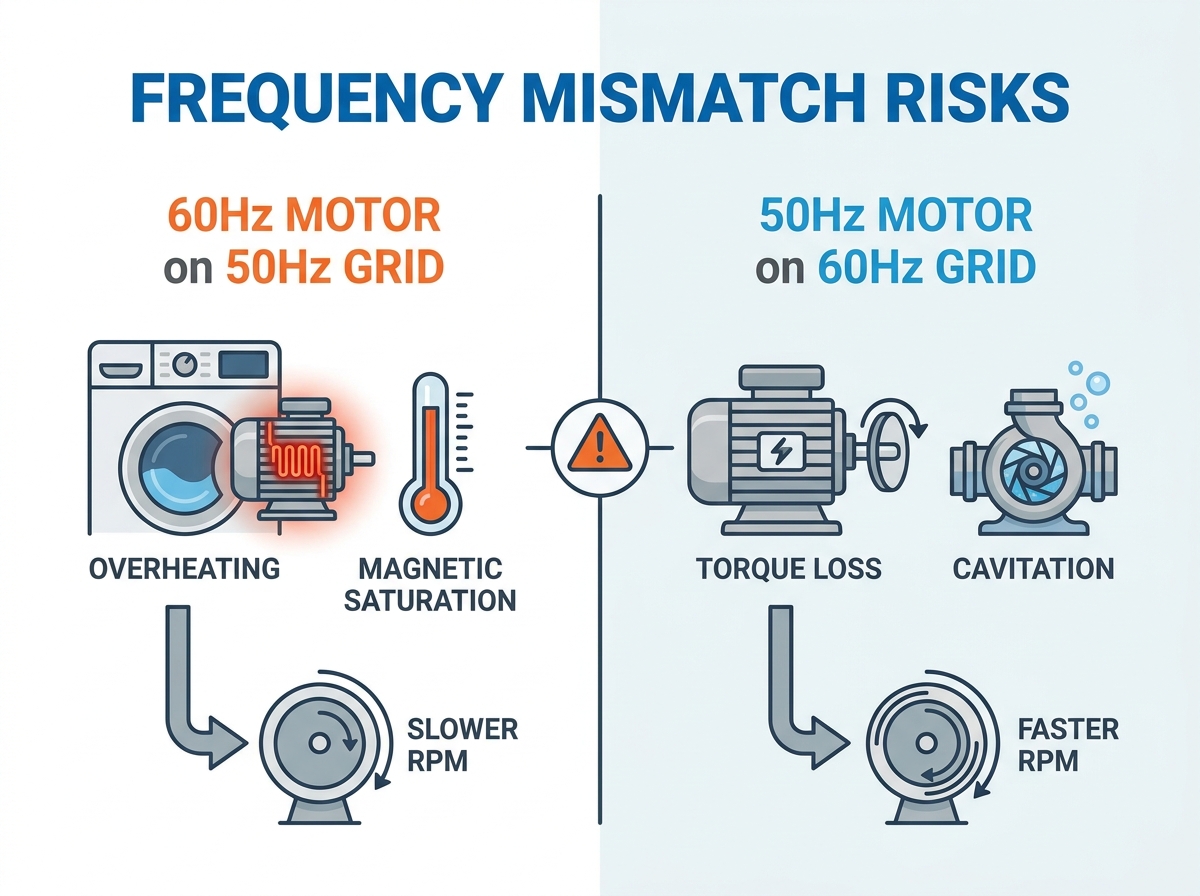
Sending a North American design (60Hz) to a European or Asian market (50Hz) introduces entirely different, often more dangerous, failure modes. The electrical mismatch here creates severe thermal hazards.
The frequency drops from 60 to 50, representing a 16.6% decrease. The unit runs slower than intended. Agitation profiles become sluggish. The machine fails to turn the clothes over effectively, resulting in poor cleaning performance and customer complaints regarding dirty laundry.
The core issue lies in magnetic saturation. A lower frequency at the same constant voltage dramatically increases the V/Hz ratio. The iron core inside the stator can only hold a specific amount of magnetic flux. Once it hits this limit, it becomes saturated.
When the core saturates, it can no longer convert electrical energy into magnetic force. The excess electrical energy has nowhere to go. It immediately transforms into raw heat. The machine begins to bake itself from the inside out.
To compensate for the inefficiency of magnetic saturation, the system draws excessively high amperage. This current spike further elevates internal temperatures. The cooling fan, which is now spinning 16.6% slower due to the frequency drop, cannot remove the excess heat quickly enough.
This trapped heat rapidly degrades the stator winding insulation. Once the protective enamel coating melts, copper wires touch each other. This creates a dead short circuit. Motor burnout is inevitable. In severe cases, this scenario presents real fire hazards, inevitably triggering costly OEM product recalls and safety investigations.
Diagnostic Chart: Electrical Frequency Mismatch Symptoms
Grid Scenario | Speed Impact | Torque Impact | Thermal Impact | Ultimate Outcome |
|---|---|---|---|---|
50Hz Motor on 60Hz Grid | Spins 20% Faster | Weakened (Struggles to start) | Runs slightly cooler (better airflow) | Stalls under load, pump cavitation |
60Hz Motor on 50Hz Grid | Spins 16.6% Slower | Spikes (Draws heavy current) | Severe Overheating (Saturation) | Insulation melts, short circuit, fire risk |
Procurement teams need a standardized baseline to evaluate supplier capabilities. We often look at 180W wash motor specifications because this wattage serves as the industry standard for medium-capacity twin-tub and specific top-load appliances.
A true 180W output perfectly balances energy consumption with mechanical agitation for typical 6 to 8-kilogram laundry loads. It provides enough force to agitate heavy denim without unnecessarily drawing excess power. When evaluating these builds, you must scrutinize the technical details.
OEM buyers must critically review motor power and torque ratings to ensure they match real-world mechanical loads.
Starting Torque vs. Rated Torque: A machine requires high starting torque to break the resting inertia of wet clothes. The starting torque must comfortably exceed the rated continuous torque. If starting torque is too low, the drum just hums and refuses to spin.
Continuous Power Output: Always verify the true 180W continuous rating under strict thermal conditions. Many suppliers market a misleading "peak" rating. A motor might hit 180W for ten seconds, but melt if required to hold that power for a 45-minute wash cycle.
Insulation dictates survival under stress. You must specify the correct thermal class to ensure adequate safety margins during prolonged, back-to-back wash cycles.
Thermal Class Comparison for Appliance Components
Insulation Class | Max Hot Spot Temp | Typical Application |
|---|---|---|
Class B | 130°C (266°F) | Standard consumer washing machines (intermittent use). |
Class F | 155°C (311°F) | Heavy-duty or commercial machines subjected to frequent overloads. |
Winding material directly impacts manufacturing budgets and long-term reliability. You generally choose between pure Copper and Copper-Clad Aluminum (CCA).
Pure Copper: Offers superior electrical conductivity and excellent heat dissipation. It resists thermal expansion cracking. It costs more upfront but guarantees lower defect rates.
Copper-Clad Aluminum (CCA): Lighter and cheaper. It appeals to procurement teams facing strict budgetary constraints. However, aluminum has higher electrical resistance. CCA runs hotter than pure copper at the exact same load. If you choose CCA, you must ensure the supplier utilizes a thicker wire gauge to compensate for the higher resistance.
Finding a supplier who understands the nuances of global grid frequencies separates successful appliance launches from costly disasters. Implement these strict criteria when auditing potential manufacturing partners.
Many OEMs desire a unified global SKU to simplify warehousing. Ask suppliers if they can engineer true 50/60Hz compatible designs. Achieving this usually requires distinct stator windings or deliberate compromises in power density. The unit must be oversized to handle the thermal demands of a 50Hz grid while accommodating the higher RPMs of a 60Hz grid. Evaluate whether this compromise fits your performance goals.
Never accept technical datasheets at face value. Demand verifiable test reports. Reliable suppliers will gladly provide dynamometer test results showing torque curves at your target frequency. Request heat run tests to prove thermal class compliance. Ask for locked-rotor data to see how the unit behaves when a drum jams.
Compliance is mandatory, not optional. Verification of regional certifications protects your business from liability. If you target North America (60Hz), you need UL certification. If you target Europe (50Hz), you require CE and VDE certifications. Ensure the manufacturer holds active, verifiable certificates for the specific models you intend to purchase.
A prototype might perform perfectly, but mass production introduces variance. Evaluate the supplier's automated winding capabilities. Automated winding machinery ensures uniform resistance and inductance across batches of thousands of units. Hand-wound units suffer from inconsistent tension, leading to unpredictable hot spots and high failure rates in the field.
Frequency mismatching in AC induction appliance components represents a fundamental engineering flaw, not a user-correctable error. The laws of electromagnetism dictate exactly how a system responds to grid frequency. Hoping a 60Hz machine survives in a 50Hz market guarantees failure.
OEM buyers carry a strict procurement mandate. You must rigidly align your component sourcing with the target market's grid. Verify that actual performance curves map perfectly to your appliance's mechanical load at the specific operating frequency. Taking shortcuts here destroys brand trust.
Before finalizing any sourcing contracts, take immediate action. Demand frequency-specific performance curves from your prospective partners. Request comprehensive thermal test data. By validating these parameters upfront, you ensure your appliances deliver safe, reliable cleaning power anywhere in the world.
A: No. Transformers only change voltage, not frequency (Hz). A 50Hz motor will still receive 60Hz from the grid even if the voltage is perfectly corrected. The induction system will still experience the exact same speed alterations and torque losses associated with frequency variations.
A: Yes, but they often require distinct design compromises. Suppliers usually oversize these units to handle the extreme thermal demands of 50Hz operations while simultaneously accommodating the speed variations inherent to 60Hz. This often decreases overall energy efficiency compared to dedicated single-frequency models.
A: Inverter-driven washing machines convert incoming grid AC power into stable DC power. The electronic control board then synthesizes the optimal frequency directly for the BLDC motor. They are generally immune to 50Hz/60Hz supply differences, provided the main power supply board is rated for the correct input voltage range.


