
 English
- All
- Product Name
- Product Keyword
- Product Model
- Product Summary
- Product Description
- Multi Field Search
English Views: 0 Author: Site Editor Publish Time: 2026-10-01 Origin: Site


Many industry professionals assume any motor bearing the "YYG-60" label serves as a universal, drop-in replacement. This common misconception creates massive headaches across repair networks. Purchasing these components solely based on a model prefix often leads to immediate installation failures or premature electrical burnout. We must look deeper into the specific operational metrics. A YYG-60 is essentially a standard 60W output device primarily utilized in twin tub spin motors. It handles the rigorous dewatering cycle in modern laundry appliances. However, surface-level labels ignore vital physical and electrical differences across varying production runs.
You need a strict evaluation framework before finalizing bulk orders or opening an appliance casing. This compatibility checklist guides procurement managers and repair technicians through essential mechanical and electrical alignments. You will learn exactly how to verify physical dimensions, assess internal materials, and validate electrical ratings. We will give you the precise tools to prevent costly equipment mismatches.
The "YYG-60" designation primarily indicates application (spin/dewatering) and output power (60W), not identical physical dimensions or wiring configurations.
Mismatches in power frequency (e.g., 50Hz vs. 60Hz) directly impact RPM, heat generation, and component lifespan.
The choice between copper vs aluminum motor windings determines the thermal tolerance and long-term durability of the unit under heavy loads.
Bench testing and verifying the wiring diagram against the specific OEM capacitor rating is a critical risk-mitigation step prior to installation.
Procurement teams face significant financial risks when assuming all YYG-60 units are identical. Incompatible parts trigger complex Return Merchandise Authorization (RMA) processing. Returning hundreds of mismatched units wastes valuable administrative hours and shipping budgets. Worse still, incompatible installations cause severe equipment downtime for end-users. Installing an incorrect motor often voids existing manufacturer warranties. You must understand the exact naming convention to avoid these operational pitfalls.
The nomenclature actually dictates a very narrow set of specifications. The first "Y" stands for Asynchronous. The second "Y" indicates a Capacitor Run design. The "G" designates its application for Spin or De-watering functions. Finally, the "60" represents 60 Watts of output power. This label tells you what the motor does. It does not tell you how the motor fits into your specific appliance.
This label fails to standardize several critical features across different manufacturers. Shaft lengths vary wildly between factories. Mounting bracket dimensions differ based on appliance chassis designs. Internal thermal protection mechanisms fluctuate from robust automatic resets to non-existent safeguards. Even standard wire colors change without notice. You cannot rely on a generic product title to guarantee mechanical harmony.
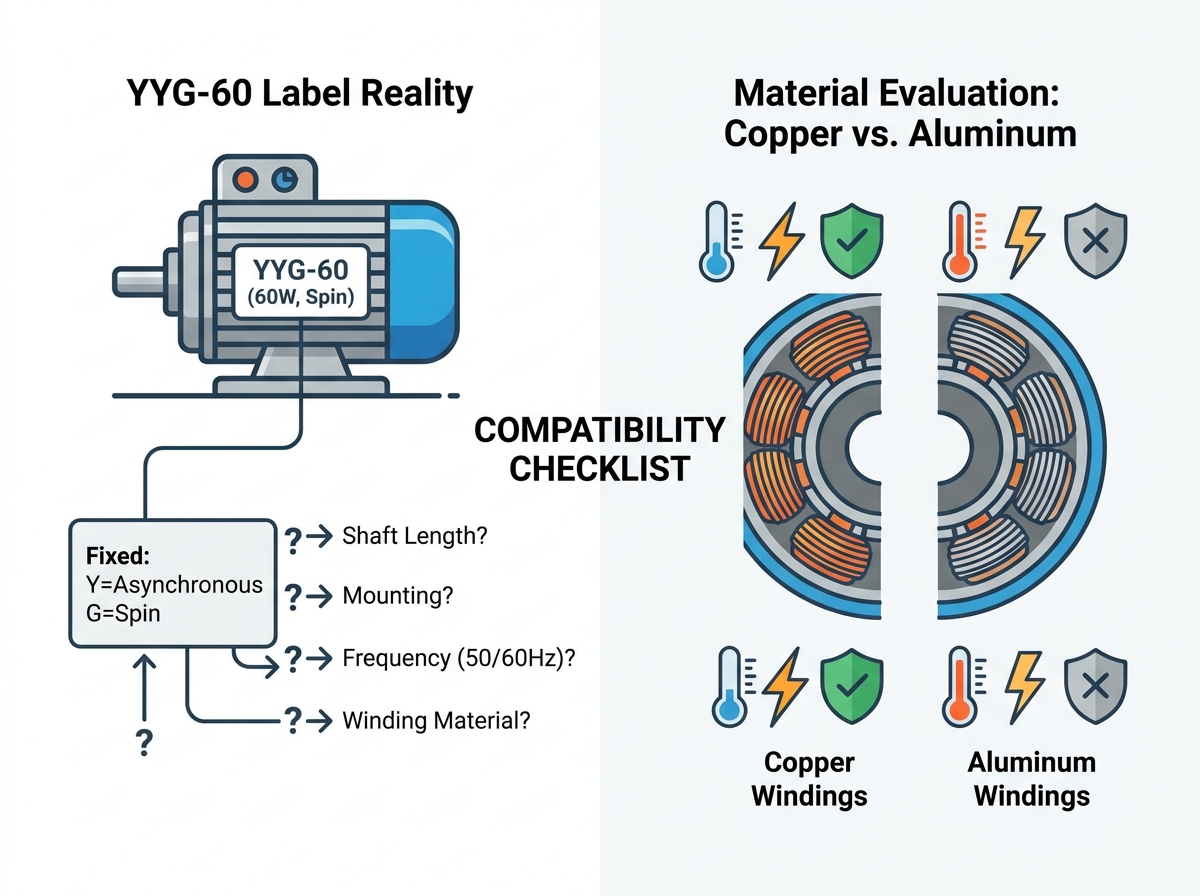
You must prioritize electrical harmony before looking at physical constraints. Regional frequency matching remains a strict requirement for asynchronous motors. Operating a 50Hz motor on a 60Hz power supply creates immediate hazards. The motor will run approximately 20% faster than intended. This incorrect RPM disrupts the dewatering balance. The increased speed causes severe overheating within the internal coils. Ultimately, the insulation melts and triggers a catastrophic short circuit.
Capacitor specifications also require exact matching. You must pair the motor with the correct microfarad (µF) and voltage rating. A common specification is 5µF/450V. If you use a capacitor with a lower µF rating, the motor lacks the starting torque to spin a heavy load of wet clothes. If you use a higher µF rating, the auxiliary coil draws excessive current. This mistake leads to rapid winding damage and inevitable failure.
Physical dimensions dictate whether the motor actually fits inside the appliance chassis. You cannot force a mismatched unit into a rigid mounting frame. Technicians should utilize digital calipers for precise measurements. Visual estimates often lead to cracked plastic couplers or excessive vibration during operation.
Shaft Diameter: Measure the exact width of the output shaft. Industry standards typically utilize 10mm or 12mm diameters. Mixing these up makes coupling impossible.
Shaft Length: Measure the total protruding length from the casing. Too short, and the brake wheel cannot attach securely.
D-Cut Depth: Evaluate the flat section milled into the shaft. This D-cut ensures the coupler grips tightly without slipping.
Mounting Distances: Measure the exact millimeter distance between the three mounting shock-absorber holes on the bottom bracket.
The internal coil material fundamentally dictates performance, longevity, and manufacturing costs. Buyers must objectively evaluate these materials based on conductivity and heat dissipation. Making the wrong choice drastically affects the appliance's lifespan. We compare these metals to guide your procurement strategy.
Specification Metric | Copper Windings | Aluminum Windings |
|---|---|---|
Thermal Tolerance | Exceptionally high. Resists melting under heavy, continuous loads. | Moderate. Prone to thermal degradation during extended cycles. |
Physical Volume | Requires smaller volume to achieve the rated 60W power output. | Requires larger wire gauge to match equivalent power output. |
Initial Expense | Higher upfront manufacturing cost. | Significantly lower manufacturing cost. |
Ideal Application | Commercial units or high-use residential appliances. | Budget-friendly, low-frequency usage residential models. |
Copper consistently offers a higher thermal limit. It pushes heat away from the core efficiently. This results in a longer operational life, especially in environments where users run multiple back-to-back laundry cycles. Copper remains the superior choice for high-use scenarios despite the higher initial cost.
Aluminum provides a lighter weight alternative. It significantly reduces manufacturing expenses, appealing to budget-focused brands. However, aluminum possesses higher electrical resistance. This resistance generates excess heat. If a user subjects an aluminum-wound motor to continuous heavy loads, the risk of thermal degradation increases exponentially.
Buyers must implement verification tactics to confirm the winding material. Never trust a spec sheet blindly. You can perform a visual inspection by carefully scraping the enamel off a cut wire. If it shines silver underneath, you have aluminum. Alternatively, compare the overall weight of two identical-looking motors. Copper is notably denser and heavier. Always request exact material datasheets directly from B2B suppliers before bulk ordering.
Validating a YYG-60 spin motor before placing it inside the chassis saves hours of frustrating labor. Implementation considerations require strict safety practices. Testing an unmounted motor applies sudden torque that can cause the unit to jump violently. You must secure it properly.
Multimeter diagnostics represent the first line of defense against faulty units. You must measure the resistance across the three protruding wires. These represent the Common, Run, and Start connections. This diagnostic process verifies winding integrity before you ever apply dangerous line voltage.
Follow these precise steps for a safe bench test:
Clamp the motor securely to a stable, heavy workbench using a specialized jig or heavy-duty vice.
Set your digital multimeter to the ohms (resistance) setting.
Measure all three wire pairs. The pair showing the highest resistance represents the Start and Run wires in series.
Identify the remaining third wire. This is your Common line connection.
Connect your appropriately rated capacitor across the identified Start and Run wires.
Apply the correct line voltage momentarily to the Common wire and the Run wire side of the capacitor. Observe the rotation direction carefully.
We strongly warn against relying on standardized wire colors. A blue wire might mean "Common" from one factory and "Start" from another. Relying on color memory usually results in a blown capacitor or a fried coil. You must follow the specific schematic printed on the motor's housing. This diagram visually dictates exactly where to locate the line connection versus the capacitor connection.
Finding a reliable supplier separates successful procurement managers from those constantly fighting product failures. A transactional vendor merely shifts boxes and ignores post-sale issues. A strategic manufacturing partner provides engineering support and transparent material sourcing. You must evaluate potential suppliers based on stringent success criteria.
Documentation demands are non-negotiable. You must require verifiable, laboratory-tested datasheets. Ask for CE and RoHS compliance certificates to ensure international safety and environmental standards are met. Furthermore, demand clear insulation class ratings. The documentation should explicitly state whether the coils utilize Class B (130°C limit) or Class F (155°C limit) insulation. Class F provides a much safer thermal buffer for heavy-duty spin cycles.
Your next-step actions should focus on empirical validation. Do not sign a high-volume MOQ (Minimum Order Quantity) agreement based on a polished brochure. Recommend ordering several sample units first. Subject these samples to destructive load testing. Run them continuously under simulated unbalanced loads until they fail. This testing validates the supplier's thermal claims and guarantees the product matches your specific durability requirements.
Securing the correct replacement part extends far beyond matching a generic prefix. A successful repair or manufacturing run requires a strict verification process. You must cross-reference physical and electrical metrics to prevent catastrophic failures.
Always measure the exact shaft diameter and flat-cut depth with digital calipers.
Verify that the motor's frequency rating matches your regional power grid precisely.
Ensure the replacement capacitor matches the microfarad rating listed on the new motor's schematic.
Choose your internal winding material based on expected usage intensity and desired longevity.
Never skip the multimeter bench test before installing the unit inside the appliance chassis.
We encourage all technicians and procurement specialists to pause before ordering. Cross-reference your current faulty motor's nameplate with this exact compatibility checklist. Taking these precise measurements now prevents costly machine downtime and complex supplier disputes later.
A: Yes, a 70W motor offers slightly more torque, but you must verify that the physical mounting dimensions match. You also need to confirm that the appliance's control circuit can handle the marginally higher current draw. Always ensure the capacitor is upgraded to match the specific 70W specification printed on the new motor.
A: Secure the motor tightly to a stable bench. Identify the Common, Start, and Run wires using a multimeter to find the highest resistance (Start + Run). Connect the appropriately rated capacitor, and apply the correct voltage momentarily. Observe the rotation direction carefully and listen closely for any unusual bearing noise.
A: It will run, but typically at a 20% higher RPM. This increased speed can cause excessive vibration, increased heat, and premature failure of the motor. It is highly dangerous if the unit is not explicitly rated for dual-frequency (50/60Hz) operation on its official nameplate.


