
 English
- All
- Product Name
- Product Keyword
- Product Model
- Product Summary
- Product Description
- Multi Field Search
English Views: 0 Author: Site Editor Publish Time: 2026-10-30 Origin: Site


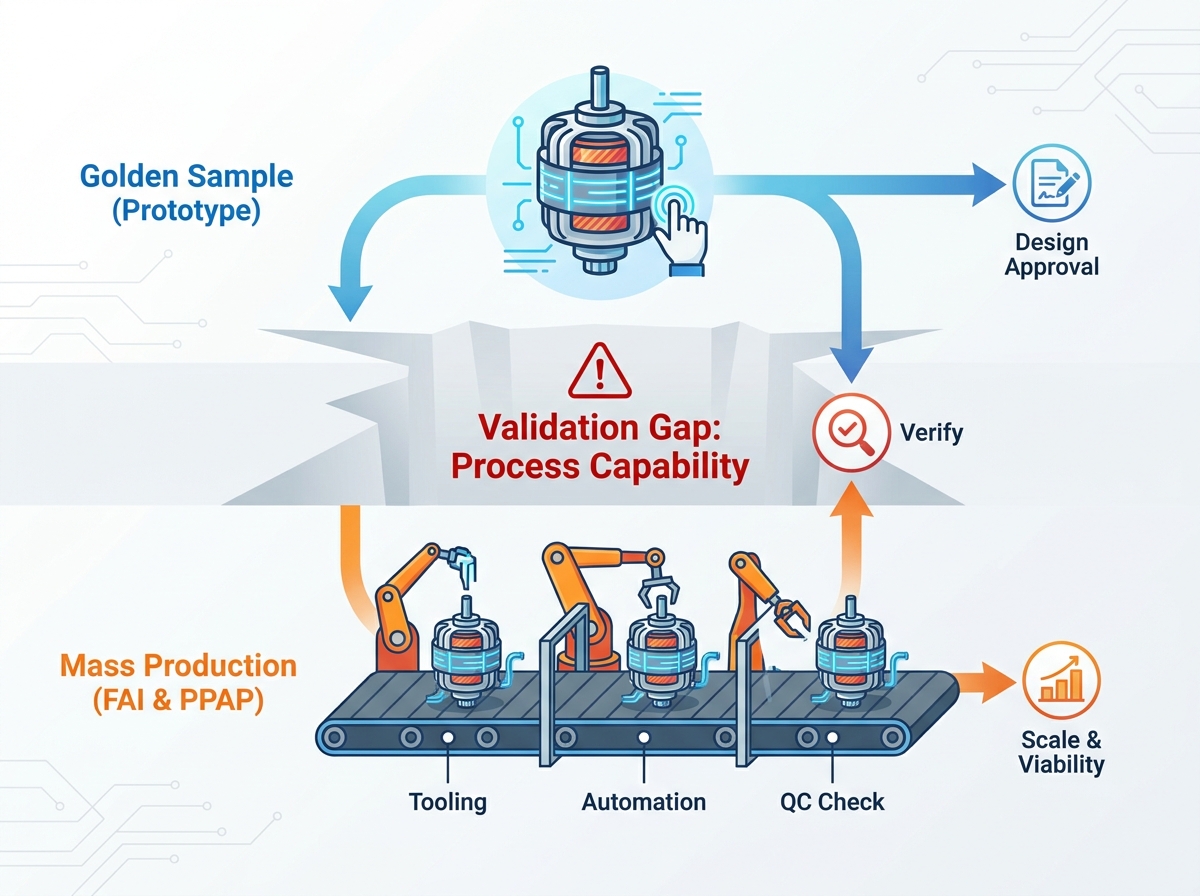
Transitioning from a prototype to mass production represents the highest-risk phase in appliance manufacturing. Your entire supply chain depends on getting this crucial step right. Unfortunately, many OEM buyers mistakenly approve a beautifully hand-built "Golden Sample" but fail to verify the factory floor reality. They forget to confirm if the production line can consistently meet those exact specifications under standard operating conditions. This oversight routinely causes unexpected line stoppages, massive product recalls, and severe margin erosion.
You simply cannot assume a pristine prototype guarantees flawless volume output. The supplier might build one unit perfectly, but mass production introduces variance. This comprehensive guide delivers a definitive framework for evaluating washing machine motors during the critical sample approval stage. By following these steps, you ensure your manufacturing partner demonstrates repeatable quality, rigorous technical compliance, and genuine scalability before you issue a final purchase order.
Golden Sample vs. FAI: A bench-made prototype proves design; First Article Inspection (FAI) proves manufacturing viability. Never confuse the two.
Production Capability is Non-Negotiable: Approving a sample requires validating the tooling, automation, and material sourcing that will produce the next 10,000 units.
Focus on Failure Points: Pay specific attention to critical processes like stator slot insulation, NVH (Noise, Vibration, Harshness) tolerances, and thermal thresholds before signing off.
PPAP Frameworks Mitigate Risk: Utilizing a Production Part Approval Process (PPAP) standardizes the data needed to confidently greenlight mass manufacturing.
Buyers often misinterpret the purpose of different sample types. You must define the Golden Sample clearly. It is the final, approved baseline unit. It meets all design, performance, and aesthetic criteria. Once signed, it serves as the physical benchmark for future dispute resolution. You lock it in a cabinet and use it to settle arguments about quality deviations.
However, you cannot use the Golden Sample to validate manufacturing readiness. This brings us to the First Article Inspection (FAI) imperative. You must evaluate the first units coming off the actual production line. These units use mass-production tooling. Standard floor operators build them, not specialized R&D engineers. You compare these FAI units directly against your Golden Sample to reveal true manufacturing viability.
Evaluate the production dimension carefully. Verify the supplier avoids "out-of-process" methods. Sometimes, highly skilled engineers hand-tweak the first batch using production tools. This manipulation hides process flaws. You must demand transparency regarding who built the FAI units and how.
Characteristic | Golden Sample | First Article Inspection (FAI) |
|---|---|---|
Primary Purpose | Proves the design concept and physical specs. | Proves the production line capability. |
Assembly Method | Hand-built or low-volume bench assembly. | Standard mass-production line assembly. |
Operators | Senior engineers or R&D specialists. | Standard shift operators. |
Tooling Used | Prototyping tools or temporary jigs. | Finalized molds, jigs, and automated fixtures. |
Take an actionable step before approval. Demand a comprehensive FAI report. This document must detail exact dimensional measurements. It should include material certifications and performance graphs. Compare these metrics side-by-side with your approved prototype data.
Motors look simple on the outside but harbor complex failure points inside. Start by profiling NVH (Noise, Vibration, Harshness). Washing machines demand strict acoustic and vibration limits. Top-loading BLDC configurations are especially sensitive. You must test the sample under varying simulated load capacities. Off-balance loads will quickly expose weak bearings or poorly balanced rotors.
Next, drill down into insulation and electrical safety. The stator slot insulation process is paramount. Washing machines operate in highly humid environments. Poor insulation inevitably leads to short circuits. Inspect the automated paper insertion process closely. Confirm the factory uses class-appropriate insulation materials. Class F (rated for 155°C) or Class H (rated for 180°C) materials are industry standards. Do not accept inferior thermal ratings.
Thermal management dictates product longevity. Ensure your sample approval includes Accelerated Life Testing (ALT) data. Motors undergo continuous start-stop cycles during everyday use. They must survive these cycles without thermal degradation. High temperatures break down winding resins over time. ALT data proves the motor design dissipates heat effectively under heavy wash loads.
Finally, verify the torque-speed characteristics. Appliance motors perform a delicate balancing act. They must deliver immense required torque at very low speeds during the agitation cycle. Later, they must maintain absolute stability at high speeds during the spin cycle. Review the performance curves. The motor must achieve these extremes without exceeding maximum current draw limits or overheating the control board.
A supplier can build five perfect units, but volume introduces chaos. You need a scalability reality check. Can they build 50,000 units maintaining identical tolerances? Ask for statistical proof. A healthy process achieves a Cpk (Process Capability Index) of >1.33. This metric ensures 99.99% of their output falls strictly within your acceptable design limits. If they cannot calculate Cpk, they cannot control their process.
Analyze the balance between automation and manual assembly. High manual intervention heavily increases variance. Identify which parts of the assembly line utilize robotics. You want to see automated copper wire winding. Manual winding creates inconsistent tension, leading to electrical hotspots. Rotor balancing should also run through automated precision machinery. Document these automated zones properly to guarantee long-term washing machine motor production capability.
Confirm tooling readiness across the entire floor. Prototyping tools wear out fast. You must verify the factory finalized the molds, jigs, and fixtures used for your FAI sample. These tools must endure volume output without rapid degradation. Ask about their preventative maintenance schedule for injection molds and stamping dies.
Demand complete supply chain transparency. A great sample built with premium Japanese bearings does no good if mass production uses untracked alternatives. Assess how the supplier procures critical sub-components. Trace their sources for rare earth magnets, precision bearings, and pure copper wire. Unapproved substitution remains a massive risk if you do not lock down the sub-tier supply chain.
Do not rely solely on digital reports. Before final sign-off, a physical or third-party audit of the specific production line must occur. Standardize this evaluation carefully. Use a structured motor factory audit checklist. A rigorous checklist removes subjective bias and forces the auditor to examine critical operational nodes.
Begin with Incoming Quality Control (IQC). You must document exactly how the factory tests incoming raw materials. Do they take the supplier's word for it? They should have in-house testing equipment. Look for spectrometers to verify magnet grading. Check for precise micrometers to confirm incoming wire gauges. If IQC fails, the entire production run is compromised from day one.
Move to In-Line Quality Control (IPQC). Look for automated, 100% end-of-line testing. Sample testing is insufficient for appliance motors. Every single unit should undergo strict evaluations before packaging. Your checklist should mandate:
Hipot Testing: To ensure dielectric withstand and insulation integrity.
Surge Testing: To detect early-stage turn-to-turn shorts in the windings.
Unloaded Spin Tests: To measure baseline current draw and detect mechanical bearing noise.
Traceability and documentation form your last line of defense. Ensure the factory utilizes barcoding or permanent batch stamping on the motor housing. If a motor fails in a customer's home, you must be able to trace it back. You need to identify the exact manufacturing shift, the specific operator, and the raw material batch. Proper traceability turns a massive recall into a small, contained quarantine.
Appliance buyers should borrow best practices from the automotive sector. Adopt the Production Part Approval Process (PPAP). This framework acts as a massive shield against implementation risks. It forces the supplier to document every variable. Demand comprehensive control plans. Require a detailed Failure Mode and Effects Analysis (FMEA). Request verified material test reports for all resins, plastics, and metals.
The "Bait and Switch" represents your primary hidden risk. Suppliers often face margin pressure after quoting a low initial price. Post-sample approval, they might execute an unapproved substitution. They swap high-grade copper winding for cheaper variants. They might use inferior potting compounds that degrade under vibration. A locked PPAP and a sealed Golden Sample prevent this margin-padding tactic.
Do not ignore transit packaging failures. Motors are extremely heavy and dense. Approving the physical product without approving the bulk transit packaging is a common mistake. Poor palletizing or weak cardboard dividers lead to disaster. Motors smash against each other during ocean freight. This results in bent output shafts or cracked plastic housings upon arrival. You must validate the drop-test data for the master cartons.
Establish clear next-step actions before issuing the mass-production Purchase Order. Draft a legally binding Quality Control (QC) agreement. This document must detail the Acceptable Quality Limit (AQL) for different defect classes. Explicitly state the financial penalties for any unauthorized material changes. Making the financial consequences clear upfront prevents supplier deviance down the line.
Sample approval is not merely about accepting a physical prototype. It is the formal validation of the supplier's entire manufacturing system. An aesthetically perfect prototype means nothing if the factory lacks the automation, tooling, and quality control to replicate it fifty thousand times. You must shift your focus from the product to the process.
Move well beyond basic functional checks. Demand comprehensive FAI data. Strictly evaluate their manufacturing scalability and enforce rigorous PPAP documentation. Lock down the bill of materials to prevent unauthorized substitutions. Ensure packaging survives the brutal realities of global transit.
Never confuse an engineering Golden Sample with a mass-production FAI unit.
Validate continuous start-stop thermal thresholds through ALT data.
Standardize physical line inspections using a structured evaluation checklist.
Implement strict financial penalties for unauthorized material substitutions.
Take proactive steps today. Consult with a specialized third-party inspection service or deploy your internal engineering team. Have them conduct a final facility audit using the frameworks discussed. Do this before you ever release the mass-production deposit.
A: An engineering sample proves the core concept and design but is often hand-built. A pre-production sample is built using the actual tooling and processes intended for mass manufacturing. It proves the factory can make the product at scale.
A: Washing machines operate in highly humid environments. If the automated insulation insertion process is flawed, it creates microscopic tears. Moisture enters these tears, leading to catastrophic electrical shorts and motor failures over time.
A: Typically, an FAI run consists of 30 to 50 consecutive units. You pull these from the active production line. This volume accurately assesses process variation and proves statistical manufacturing capability.
A: While valuable, relying exclusively on self-reported data carries a high risk of confirmation bias. It is highly recommended to validate critical sample performance metrics via independent, third-party laboratory testing.


